

Future content will be found at https://db.barbanon.org/.
Moving…
Posted by Tracy Poff on March 27, 2020
Posted in Uncategorized | Tagged: toredir | Leave a Comment »
First Impressions: Magic: The Gathering – Duels of the Planeswalkers 2013
Posted by Tracy Poff on July 8, 2012
I played an hour or so of the demo for Magic: The Gathering – Duels of the Planeswalkers 2013. I think it’s a fairly good conversion of the game, but severely lacking in customizability.
Without the ability to build unique decks from the available cards, mixing and matching as desired, it’s just not the same–half the game, at least, is building a deck, but DotP 2013 just lets you swap cards between a deck and its sideboard, AFAICT, which is very limiting.
There’s also a fairly small number of cards available–a sixty card deck and a 30 card sideboard, but a third of the deck is land and there are many cards that appear three or four times in the decks. I guess each of the ten decks has perhaps 30 distinct cards, counting the sideboard, so there are only about 300 cards total, assuming each deck has entirely unique cards, and since you can’t swap cards between decks (I think), you can’t be too creative.
Other than that, it was pretty good–it took a little getting used to the game before I was sure when I needed to stop the timer to play instants–the game shows which phase you’re on, but not which step, so I missed playing an instant after blockers were declared once. It’s not too confusing, though. The animations are a little slow, and I think that I may have toggled an option which made the game stop during damage resolution during combat, which was a pain, but probably my fault.
One thing I didn’t care for was the Planechase mode. It’s a multiplayer (up to four players) mode, which is fine, but the use of the plane cards just made the game confusing–I saw a card that made players mill seven cards at the end of each turn, then draw one of them randomly back out of the graveyard, and another that made non-werewolf creatures deal no damage, plus some ability that sometimes made creatures into werewolves, and yet another that had some other odd combat ability which benefited one player dramatically more than the others. Honestly, I’m not totally sure how the plane cards work–they seem to act like global enchantments, and there’s some die rolling mechanic that goes with them. They just seemed to complicate and slow down the game. I gave up after many minutes and only three turns of play in that mode. I’ll stick to the more traditional game, thanks.
Well, DotP 2013 won’t replace the real game, but I think it’s not a bad buy at $10, and if I can get it for half off some time, I might pick it up.
Posted in 2012, Card Game, Decent, First Impressions, Strategy, Windows | Tagged: Stainless Games, toreview, Wizards of the Coast | Leave a Comment »
Towers of Hanoi (1987)
Posted by Tracy Poff on June 2, 2012
Towers of Hanoi by Daniel Miller is a 1987 update of his 1985 Tower of Hanoi game of the same name.

While substantially the same, this game is much improved compared to its predecessor. The animation of the discs is much quicker, which cures the major problem with the previous game, and it also registers when you’ve won, rather than just going on forever. The game also beeps when moving discs, though that sound effect is quite primitive for 1987.

Towers of Hanoi was published in Loadstar #39, as well as Best of Loadstar #4. Hard to imagine a simple game like this being included in any kind of ‘best of’ compilation, but there it was.
Posted in 1987, Commodore 64, Decent, Full Review, Tower of Hanoi | Tagged: Daniel Miller, not on mobygames, toreview | Leave a Comment »
Pyramidon
Posted by Tracy Poff on June 1, 2012
Pyramidon is a 1987 Tower of Hanoi game by M. Kötter.

Wow, is this game different from the last dozen or so I’ve reviewed. Just look at that lovely title screen! It’s got sound, nice graphics, a plot, everything you could ask of a game. Well, almost everything. It’s not much fun, but nobody’s perfect, right?
As far as I can decipher (German is not my strong suit, I fear), you are an astronomer who has discovered that a comet is on its way, and will strike a pyramid. Naturally you decide to save the pyramid… with a flying saucer. I’m not too sure how you got your hands on one of those, but… well, maybe you’re an alien astronomer.
You may choose between three difficulty levels, the harder difficulty levels having you rescue larger pyramids. The easiest, Menkaure’s pyramid, has three levels (corresponding to the three-disc Tower of Hanoi puzzle); the second, Khafra’s pyramid, has four; and the hardest, Cheops’s pyramid, has five.
Having selected the difficulty, you’re presented with the pyramid you chose in the center of the screen, and your task is to move it to one side by lifting the layers and solving the Tower of Hanoi puzzle.

While you’re doing this, a meter at the bottom of the screen shows how far away the comet is. Should you succeed in moving the entire pyramid before time runs out, you’re given a score based on how much time was left. You’re also treated to an animation of the comet smashing into the Earth where the pyramid used to be. Should you fail, you still get to see the same animation, but it destroys the pyramid and you get no score. Bad astronomer!
Unlike most of the other Tower of Hanoi games I’ve reviewed so far, which are more like computerized puzzles, Pyramidon is really game-like–it even gives you a score at the end. Unfortunately, the flying saucer moves very slowly; it took me ten minutes to beat the highest difficulty level, and I doubled the emulation speed after a while because it got too boring waiting on the movements to finish. I guess you have about fifteen minutes on the timer when you start, and it takes most of that time.
The game also has a slight problem with the controls. When the flying saucer is moving up or down, you can reverse direction, in case you started moving by accident, which is very convenient. When moving left or right, though, you can’t do this–you have to wait for the flying saucer to finish the movement before you can reverse it. Perhaps accidentally going the wrong way wouldn’t have been a problem on a real C64, with a real joystick, but the analog stick on my gamepad made it pretty easy to go the wrong way, so this missing feature made an already seemingly-interminable game take even longer.
I regret that the first really polished looking Tower of Hanoi game I’ve come to has such poor gameplay, but I’m afraid that’s how it is: I recommend against playing this one, unless you’re quite patient.
Posted in 1987, Bad, Commodore 64, Full Review, Tower of Hanoi | Tagged: M. Kötter, not on mobygames, toreview | Leave a Comment »
Blocktower
Posted by Tracy Poff on June 1, 2012
Blocktower is a 1987 Tower of Hanoi game for the Commodore 64, released by Wicked Software.


This seems to be exactly the same as Blocks from the previous year, with the title changed, and both seem to be copies of Glen Fisher’s Tower of Hanoi games. Blocktower was published in The Big 100, a collection of games. It seems they just copied a bunch of games from wherever–in fact, it appears that four of the hundred games in the collection are just copies of four others, with different filenames. That’s quality.
So bad was this collection that it inspired a competition to write terrible games. Oh, Internet, what would we do without you?
Posted in 1987, Bad, Commodore 64, Full Review, Tower of Hanoi | Tagged: not on mobygames, toreview, Wicked Software | Leave a Comment »
Discos en Torres
Posted by Tracy Poff on June 1, 2012
Discos en Torres is a 1986 Tower of Hanoi game for the Commodore 64, and apparently a translation of Glen Fisher’s Hanoi from 1984.

Besides the translation, this game differs only in very minor ways from Hanoi: the title screen is modified slightly and some text is recolored, but it seems to be otherwise the same.

Unless you prefer solving puzzles in Spanish, there’s no reason to play this one.
Posted in 1986, Bad, Commodore 64, Full Review, Tower of Hanoi | Tagged: not on mobygames, toreview | Leave a Comment »
Blocks
Posted by Tracy Poff on May 31, 2012
Blocks is a 1986 Tower of Hanoi game for the Commodore 64, released (according to GB64) by Robtek Ltd.

This one seems very much like a recolored version of Glen Fisher’s Hanoi. I’d be surprised if it weren’t based on it or one of its successors. As a result, my opinion of this one is the same as with those–it’s functional, but not worth a second look.
Posted in 1986, Bad, Commodore 64, Full Review, Tower of Hanoi | Tagged: not on mobygames, Robtek Ltd., toreview | Leave a Comment »
Towers of Hanoi (1985)
Posted by Tracy Poff on May 31, 2012
Towers of Hanoi by Daniel Miller is a 1985 Tower of Hanoi game for the Commodore 64.

This is just your standard Tower of Hanoi game, with a couple of differences: first, it doesn’t seem to be able to tell when you’ve won, instead requiring the player to press F1 to quit; second, pressing F1 during play will offer the option of having the computer solve the puzzle.
The animation of the discs moving is quite slow, making it rather boring to solve–it takes fully seven seconds to move a disc from the bottom of the left stack to the bottom of the right stack.
This would just be a rather poor Tower of Hanoi game, worthy of no particular notice, if it weren’t for one thing. Towers of Hanoi was published in the June 1985 issue of Ahoy!, a magazine for Commodore users–in fact, it was mentioned on the cover–and the writeup for the game is really great. It gives Lucas’s story about the priests in the temple moving discs about, counting down to the end of the world; it discusses the number of moves required to solve the puzzle; and it also describes some programming tricks the game uses quite lucidly. It’s a lovely little article, the sort that I really enjoy reading. It’s just a pity it wasn’t attached to a better game.
Posted in 1985, Bad, Commodore 64, Full Review, Tower of Hanoi | Tagged: Daniel Miller, not on mobygames, toreview, type-in games | 1 Comment »
Stack
Posted by Tracy Poff on May 31, 2012
Stack by Glenn W. Zuch is a 1985 Tower of Hanoi game for the Commodore 64 with stunningly bad design.

I’ve opened this on a rather strong assertion, but it’s really deserved. For all the games I’ve reviewed so far, the worst thing you could really say about them was that they were unoriginal, boring, and ugly. Certainly flaws, but totally common ones and not entirely the fault of the authors.
Stack takes badness one step further–or a dozen. Behold:
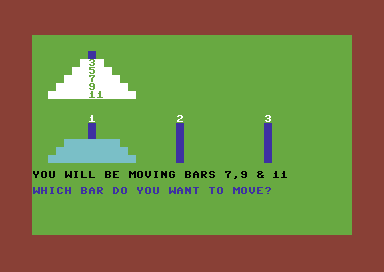
Both the bars and the stacks are numbered, and rather than, as with every previous Tower of Hanoi game, selecting the source and destination stacks, you first select the bar you want to move, and then the stack you want to move it to. So solving the two-bar game, involves moving bar 9 to stack 2, bar 11 to stack 3, and then bar 9 to stack 3. Why weren’t the bars numbered 1 to 5 instead of 3, 5, 7, 9, 11? Who knows. But that’s not even the worst of it. Observe the game when a few moves have been made:

Each time you make a move, Stack redraws the stacks below the old ones, but it doesn’t tell you what the numbers are. So, you’ve got to keep in mind that in this case the medium sized bar is number 9, when you want to move it. How much worse it would be with five bars.
This is a horrible design choice with really no excuse. It’s a poor decision even if you’ve never seen a Tower of Hanoi game before, but by 1985 there were plenty of better examples.
This was a type-in game in the December 1985 issue of RUN (Issue #24), and the description there is priceless. It was written, I presume, by the author of the game, and repeats how easy the game is to play, while the underlying puzzle is difficult–not quite. Best of all is the one-sentence blurb introducing Stack: “Moving a few bars from one pile to another sounds easy, until you try this game.”
Yeah, that sounds about right.
Posted in 1985, Bad, Commodore 64, Full Review, Tower of Hanoi | Tagged: Glenn W. Zuch, not on mobygames, toreview, type-in games | Leave a Comment »
Hanoi (1984)
Posted by Tracy Poff on May 30, 2012
In 1984, a final (to my knowledge) update to Glen Fisher’s Hanoi was released, also called Hanoi.

The gameplay is identical to its predecessors from 1978 and 1980. The only difference is that this 1984 version includes color–quite a bit more than the 1980 version, and in contrast to the monochromatic 1978 version.
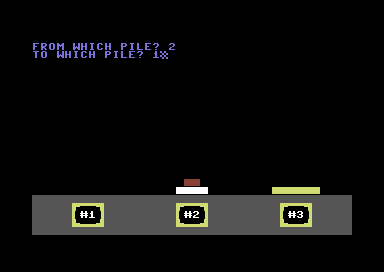
I suppose that this version is the best of this lineage, which isn’t really saying much. Of course, for a Tower of Hanoi game, there isn’t much to say.
This version was released as a type-in game in Commodore 64 Fun and Games by Jeffries, Fisher, and Sawyer.
Posted in 1984, Commodore 64, Decent, Full Review, Tower of Hanoi | Tagged: Glen Fisher, toreview, type-in games | Leave a Comment »
 Too Much Free Time